

.jpg)
Ending world hunger is at the core of the second Sustainable Goal of the United Nations. Despite global progress throughout the years, hunger persists due to worldly events, including the pandemic, conflicts, and climate change.
Nearly 282 million people in 59 countries and territories experienced high levels of acute hunger according to the 2024 Global Report on Food Crises by UNICEF USA. Conflict remains one of the biggest drivers of food insecurity, affecting 135 million people in 20 countries. Economic shocks also affect 21 countries where around 75 million people face food insecurity due to dependence on food imports. Furthermore, extreme weather is also a factor with significant impacts in 18 countries and 77 million people.
The recent years have seen a streak of record-breaking temperatures. According to the World Meteorological Organization, 2024 has been confirmed as the warmest year on record, based on six international datasets. The global mean temperature reached 1.5°C above pre-industrial levels. Despite the cooling from La Niña, 2025 was also confirmed as one of the three warmest years on record.
Addressing climatic factors and effects is vital in pursuing a world without hunger. But how does climate affect food security?
Climate and Agriculture
Agriculture is an essential industry to our global economy and food security, producing the very food that we eat every day. However important the sector is, agriculture is highly dependent on nature and climate.
Climate can affect food availability, quality, and safety. Crop yields can be significantly affected by changing temperatures and frequencies of extreme weather conditions. Increasingly, warmer temperatures may promote pests and contribute to spoilage and contamination. Furthermore, severe weather events can disrupt deliveries and transport and result in higher prices.
Climate impact has been observable in the recent event: the El Niño in 2023, one of the five strongest on record. El Niño is a natural phenomenon associated with warming ocean waters in the central and eastern Pacific Ocean, influencing weather patterns across the globe. With greenhouse emissions from human activities, this recent phenomenon has contributed to record-high temperatures.
Related: El Niño: What It Means to Agriculture
Southeast Asia is one of the affected regions, wherein the agricultural sector has faced serious problems due to drought. In the Philippines alone, El Niño resulted in damages worth PHP 9.5 billion (166.6 million USD) as of May 2024. Production losses have impacted the country’s staple grains such as rice and maize.
The 2023 El Niño also caused heavy rains and flooding in Eastern Africa during the March to May season, affecting and displacing people across the region. The intense weather has damaged infrastructures and farmlands while also increasing the risk of water-borne diseases. On the other hand, Southern Africa experienced scorching heatwaves and the lowest mid-season rainfall in 40 years. The drought lowered the harvest of staple maize by 25% in South Africa and up to 72% in Zimbabwe.
La Niña conditions had been forecasted in mid-October 2025 to persist until February or March 2026. Temperatures are expected to remain above average across all tropical and subtropical regions globally. This phenomenon is likely to strengthen hurricane and cyclone activity across the north and southwest Indian Ocean and the Atlantic. Flooding, landslides, drought, heatwaves, pests, and diseases are also anticipated hazards in the affected regions.
Without a doubt, the climate has a profound impact on agricultural productivity and food security. This impact extends further to the post-harvest processing of crops, most apparent during the drying stage. Sun or field drying is still a common practice by many smallholder farmers. While this traditional method is cost-efficient, the growing unpredictability of the weather has affected its reliability in ensuring the quantity and quality of drying crops.
Related: How to Use Sustainable Climate-Smart Drying Solutions
Proper solutions have become a must-have to address the challenges of climate and aid in improving food security. Likewise, adaptable food storage solutions are vital in preserving staple commodities even during lean periods and devastating events — a step in the direction of the second sustainable goal.
How Adaptable Food Storage Can Help End World Hunger
The goal of Zero Hunger is not a simple task; it requires a multi-dimensional and coordinated approach. Collective action and policies are a must to transform food systems, promote sustainable agricultural practices, and mitigate the impact of conflicts, climate, and the pandemic on global food security.
One important action is lessening post-harvest food loss, which amounts to a loss of 13.2% every year. These losses undermine the sustainability of food systems, wasting not only food that can be consumed but also the resources used in its production.
Transforming the food system may start with implementing a sustainable and adaptable approach to lessening post-harvest food losses. For dry agricultural commodities like staple grains, seeds, and other value crops, proper storage is as important as proper drying to secure both quality and quantity. This raises an important question: what can be considered a proper storage solution?
1. Proper storage maintains the ideal moisture level.
Ensuring the ideal or optimal moisture level is a must to prevent quality deterioration in dry agricultural commodities. Whether through improper drying or reintroduction during storage, excess moisture creates an ideal environment for mold growth, which can lead to health risks and spoilage.
2. Proper storage protects from infestations.
Many pests thrive in warmer temperatures and feed on stored grains, resulting in damaged quality and weight loss. Apart from sufficient protection from insects outside, a good storage unit also provides a way to easily inhibit and eliminate embedded infestations.
3. Proper storage should be adaptable and climate-smart.
Aside from heatwaves, heavier rains and floods cause massive damage to commodities before and after harvest. Great post-harvest storage must be able to keep up with the negative effects of climate change.
Adaptable food storage is an especially valuable investment. Adaptable, flood-proof, and weather-resistant are great characteristics to secure staple crops and seeds for better food availability in later seasons. Furthermore, climate-smart food storage also lessens greenhouse gas emissions that contribute to climate change, by preventing post-harvest food losses and implementing chemical-free practices in specially innovative solutions.
Hermetic Technology: An Adaptable Food Storage Solution
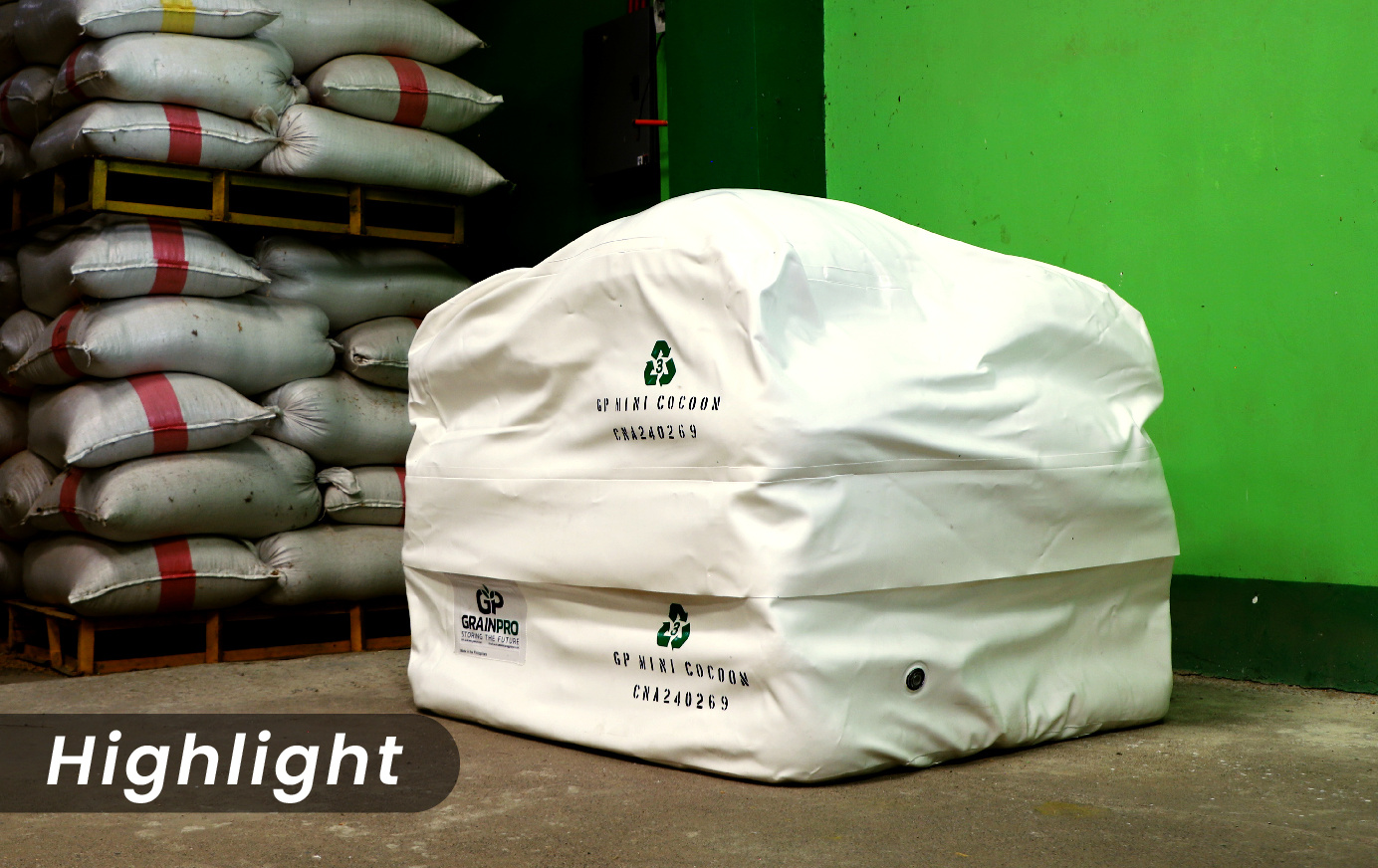
Hermetic Technology uses airtight barriers to effectively block air and moisture exchange. This concept creates a controlled atmosphere, a stable environment mostly unaffected by external factors. Additionally, it works with the respiration of embedded pests to deplete oxygen levels, allowing for a natural and chemical-free way to inhibit infestations through asphyxiation.
Learn More: Beginner’s Guide to Post-harvest Hermetic Technology
Hermetic Technology is a viable and reliable option for the post-harvest storage of various dry agricultural commodities. After a successful setup, a hermetic storage unit can also minimize damage from the outside environment, including exposure to sun, rain, and temperature fluctuations.
This climate-smart adaptability is one of the main benefits of the Cocoon™. Stored commodities within a Cocoon™ are well-protected against flood below its zipper line. This large-scale solution is applicable for both indoor storage and outdoor installation, especially with the added UV protection of the GrainShade™. Additionally, the Cocoon™ also allows for easy monitoring of humidity and oxygen levels during its operation.
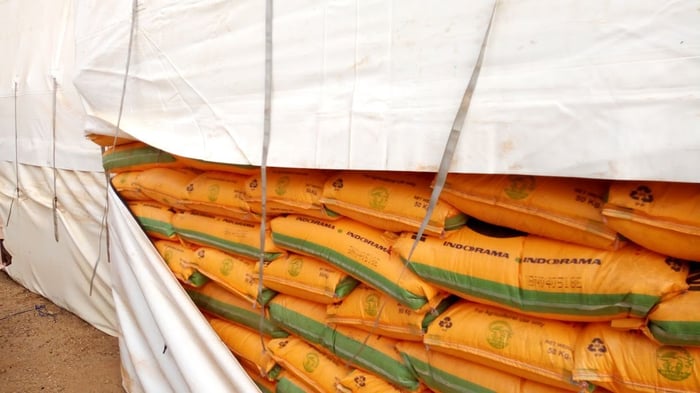 In Photo: Cocoons™ storing agricultural commodities in Nigeria
Another long-term food storage worth mentioning is the Hermetic Bag™. This opaque, small-scale hermetic solution is 500 times more airtight than traditional liners, which effectively blocks out external factors like air, moisture, and UV light. Hermetic Bag™ comes in zipper and twist-and-tie variants, adding a layer of protection for dry agricultural commodities stored and transported in jute bags of 5 to 69 kg.
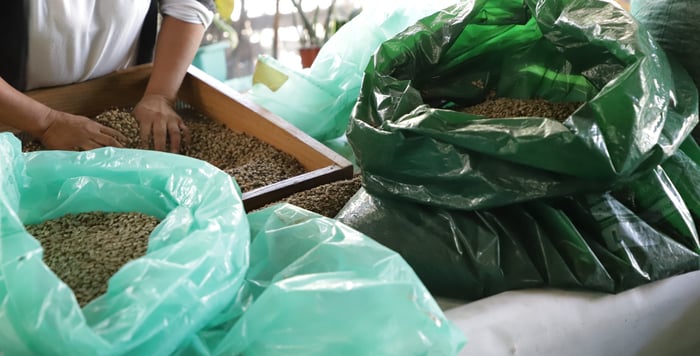 In Photo: Old (left) and new (right) Hermetic Bag Premium™ used in coffee production in the Philippines.
Samples of 2.5 kg or less can also benefit from the Hermetic Pouch™, a resealable and reusable stand-alone storage solution. The Hermetic Pouch™ is sufficiently airtight, moisture-proof, and available in opaque colors for UV protection — perfect for preserving highly sensitive commodities like coffee, spices, and heirloom rice.
While only one of the many adaptations to take, utilizing reliable, resilient, and adaptable food storage is already a step closer to a future with better food security and availability.
Learn more about GrainPro’s adaptable hermetic storage solutions by clicking the button below.

Date Published: October 1, 2024
Share this article